List of Super Smash Bros. series bosses
This is a list of Super Smash Bros. series bosses and other special opponents.
Debuting in Super Smash Bros.[edit]
The original Super Smash Bros. features several scripted encounters against opponents with a special aspect to their battles. Later games often feature similar battles, but remove the specifically scripted nature in many cases; some of these the player is also able to emulate with certain battle options in later games.
Yoshi Team / Kirby Team / Fighter Team[edit]

- Main article: Yoshi
A large amount of relatively weak, multicolored Yoshis appears as a group encounter in Super Smash Bros., and later a group of Kirbies with different abilities appear in a similar fight. Both return in later games in differing capacities. Starting with Super Smash Bros. Melee, randomized opponents can appear at scripted intervals as a multicolored team.
Names in other languages[edit]
| Language | Name | Meaning | Note(s) | Ref. |
|---|---|---|---|---|
| Japanese | ?軍団 ? Gundan | ? Army | "?" being the name of the character | [?] |
Mario Bros. / Two-vs-two fighters[edit]
Mario and Luigi appear together as a team encounter (referred to by subtitles and narration as Mario Bros.) in Super Smash Bros., with the player getting a randomized CPU opponent. Later games have all three of the CPU characters randomized except for specific pre-determined events (such as Mario and Pit fighting Link and Yoshi in Adventure Mode: The Subspace Emissary from Super Smash Bros. Brawl) and they vary from selectable team battles in that the fighters are not color-coded.
Giant Donkey Kong / Giant fighter[edit]

- Main article: Giant Donkey Kong
Giant Donkey Kong appears as a boss in Super Smash Bros. and Super Smash Bros. Ultimate, also making occasional event appearances on other games. Starting with Super Smash Bros. Melee, randomized opponents can appear at scripted intervals with a permanent Super Mushroom effect and are referred to as "Giant" fighters; certain events and other intervals have specific giant fighters appear, such as Kirby or Bowser.
Metal Mario / Metal Luigi / Metal fighter[edit]

- Main article: Metal Mario
Metal Mario appears as a boss in Super Smash Bros., Super Smash Bros. Melee, and Super Smash Bros. Ultimate. In Super Smash Bros. Melee, he is accompanied by Metal Luigi if Luigi is unlocked. Starting with Super Smash Bros. Melee, randomized opponents can appear at scripted intervals with a permanent Metal Box effect and are referred to as "Metal" fighters.
Multi-Man mode enemies[edit]
The enemies of the Multi-Man battle modes have appearances and localized names that differ by game, but a consistent role and Japanese name. They possess very little attack and defense prowess, but their numbers can pose a threat. In "cruel" mode, their offensive and defensive abilities are increased to the point that even a single one is a dangerous opponent.
Super Smash Bros. (Fighting Polygon Team)[edit]
- SmashWiki article: Fighting Polygon Team

Super Smash Bros. features the Fighting Polygon Team (also simply called the Fighting Polygons). As the Multi-Man battle modes were not introduced until Super Smash Bros. Melee, they only appear in the 1P Game mode: three appear in the "Race to the Finish" minigame, and afterwards, the player fights 30 of them in the penultimate stage. Their bodies are all the characters' basic polygon structure (hence their name), all colored purple. Their designs appear edited from the original model. They do not have the voices of the characters they are modeled after, making them completely silent. For example, Kirby's version appears as a cake, and Yoshi's version has three teeth. Mario, Luigi and Ness' versions look very similar to each other, only being told apart by their moving pattern (Ness's version makes the same glittering noise of the real Ness when jumping) and that the Ness one's nose is lower than Mario one's nose.
Gallery[edit]
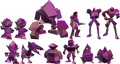 Every member of the Fighting Polygon Team.

Super Smash Bros. Melee (Fighting Wire Frames)[edit]
- SmashWiki article: Fighting Wire Frames

Super Smash Bros. Melee has the Fighting Wire Frames. Wire Frames have female and male versions which respectively have the same attack pattern as Zelda and Captain Falcon (minus the special moves), and are constructed of purple wires with the Super Smash Bros. symbol for a face and internal organs visible. A group of them is fought in Adventure Mode in low-gravity, along with being in every option for Multi-Man Melee.
Super Smash Bros. Brawl (Fighting Alloy Team)[edit]
- SmashWiki article: Fighting Alloy Team

Super Smash Bros. Brawl features the Fighting Alloy Team, four colorful robot-like creatures. The Red Alloy is modeled after Captain Falcon, the Blue Alloy after Zelda, the Yellow Alloy after Mario, and the Green Alloy after Kirby. Here, they are unique to Multi-Man Brawl, as they do not factor into Classic Mode nor Adventure Mode: The Subspace Emissary. However, they are alluded to in Super Smash Bros. Ultimate by appearing as an Advanced-class support spirit that occupies one support slot. Fighters that use this spirit will start a battle with a Ray Gun. The spirit battle takes place on the Battlefield form of Final Destination, where the player faces four Captain Falcons, four Zeldas, four Marios and four Kirbys.
Later games (Fighting Mii Team)[edit]
- SmashWiki article: Fighting Mii Team

Every later game instead features the Fighting Mii Team. The Fighting Mii Team uses Miis that are saved in the player's system; the Miis' heads are loaded onto a pre-set body and are randomly given either the Mii Brawler, Mii Swordfighter, or Mii Gunner moveset, albeit without special moves, grabs, and the abilities to pick up items and grab ledges.
Names in other languages[edit]
| Language | Name | Meaning | Note(s) | Ref. |
|---|---|---|---|---|
| Japanese | 謎のザコ敵軍団 Nazo no Zakoteki Gundan | Mysterious Small Fry Enemy Corps | [?] | |
| Chinese (Traditional) | 謎之雑兵軍團 Mí zhī Zábīng Jūntuán (Mandarin) Màih jī Jaahpbīng Gwāntyùhn (Cantonese) | Mysterious Small Fry Enemy Corps | [?] | |
| German | Metalloid | Portmanteau of metall ("metal") and "android"; also a pun on "metalloid" | [?] | |
| Italian | Zaamar | Portmanteau of "zamak" and armata ("army") | [?] | |
| Sagoma | Shape | Super Smash Bros. Melee | [?] | |
| Spanish | Aleados | Pun on aleación ("alloy") and aliados ("allies") | [?] | |
| Modelos 3D de Lucha | 3D Fighting Models | Super Smash Bros. Melee | [?] |
Master Hand[edit]

- SmashWiki article: Master Hand
Master Hand is the main antagonist and one of the bosses of the Super Smash Bros. series. He is a large, disembodied, right glove who appears in every Super Smash Bros. game, and he first appears in Super Smash Bros.
Master Hand is voiced by the announcer of each game in the series; Jeff Manning in the original, Dean Harrington in Super Smash Bros. Melee, Pat Cashman in Super Smash Bros. Brawl, and Xander Mobus in Super Smash Bros. for Nintendo 3DS / Wii U and Super Smash Bros. Ultimate. The voicework is typically limited to a deep cackle at the beginning of the fight and sometimes a shout upon defeat.
- Master Hand's laugh in Super Smash Bros.
- Master Hand's laugh in Melee
- Master Hand's laugh in Brawl
- Master Hand's laugh in for 3DS / Wii U and Ultimate
Super Smash Bros.[edit]


In Super Smash Bros., after a character has defeated every challenger in 1P Game, they are transported to a battlefield known as "Final Destination", where they battle Master Hand. After defeating him, players revert to their doll state.
Master Hand also briefly appears in the opening, where he brings out dolls representing the various playable characters as well as dioramas representing various stages and then snaps his fingers upon counting down to bring them to life.
Super Smash Bros. Melee[edit]

Master Hand reappears in Super Smash Bros. Melee as the embodiment of creation. In Classic mode, the battle against Master Hand in this game is nearly identical to that of the original Super Smash Bros.; after defeating all opposition, the player faces Master Hand in Final Destination. If the player clears all stages on the Normal difficulty or higher within 10 minutes without using a continue, Crazy Hand appears once Master Hand has lost half of his HP. Once defeated, Master Hand falls back into the void of Final Destination as the screen fades to white. The player reverts into a trophy, appearing among the trophies of others who have defeated Master Hand.
Master Hand and Crazy Hand also appear in Event 50: Final Destination Match, where the player must battle the duo with 300 HP each.
There is a glitch that allows the player to play as Master Hand through use of the third GameCube controller port.
Super Smash Bros. Brawl[edit]


In Super Smash Bros. Brawl, Master Hand is featured as a boss in both Classic and Boss Battles modes. Crazy Hand joins him under the same circumstances as in Super Smash Bros. Melee, but unlike the previous game, Crazy Hand appears immediately alongside Master Hand when the battle begins. Master Hand plays a brief role in Adventure Mode: The Subspace Emissary, but despite this, he is not fought as a boss in the mode.
In The Subspace Emissary's storyline, Master Hand makes his debut as the leader of the Subspace Army, commanding Ganondorf, Bowser, and Wario. However, near the end, it is discovered that Master Hand is being controlled by Tabuu via the chains of light in order to trick Ganondorf, Bowser, and Wario into drawing the entire world into Subspace. Angered, Ganondorf attempts to attack Tabuu, but he is blocked by a force field and turned into a trophy upon smashing into Master Hand. This severs the chains holding Master Hand, which tries to fight Tabuu but is knocked to the ground by the force field, where he lies unconscious for the remainder of the mode. When Master Hand is knocked out, he does not turn into a trophy as everyone else does.
Super Smash Bros. for Nintendo 3DS[edit]

Master Hand returns again in Super Smash Bros. for Nintendo 3DS, as the final opponent in Classic mode. At intensity level 3.0 to 7.9, the player will have the option to fight either Master Hand alone or together with Crazy Hand. At 8.0, the player is forced to fight Master Hand with Crazy Hand.
At 5.1 and above, if the player faces both Master Hand and Crazy Hand, after enough damage is dealt, Crazy Hand will be engulfed in purple flames and exit the battle, while Master Hand begins to alter and faces the player as Master Core.
Super Smash Bros. for Wii U[edit]
Master Hand also appears in Super Smash Bros. for Wii U with a new mode called Master Orders and may also appear in Crazy Orders if the player clears a certain amount of tickets before facing Crazy Hand. Much like in the 3DS version, he is the final boss of Classic mode and can transform into Master Core.
Super Smash Bros. Ultimate[edit]
Master Hand reappears in Super Smash Bros. Ultimate as a boss in both Classic Mode and Adventure Mode: World of Light. For the first time since the first Super Smash Bros., Master Hand can face right. In World of Light, an army of clones of the original Master Hand serve under the villain Galeem. When the player fulfills all requirements for the game's true ending, the original Master Hand and Crazy Hand open a giant rift in the sky, which the former enters.
For the first time, Master Hand is playable through normal means, as he is pitted in a Mob Smash-esque match against 50 light and dark false characters.
Master Hand also appears as an Ace-class Neutral-type primary spirit. It allows three support slots and is obtainable by winning the last battle against Master Hand in World of Light. It is among the most powerful spirits in the game.
Gallery[edit]


Names in other languages[edit]
| Language | Name | Meaning | Note(s) | Ref. |
|---|---|---|---|---|
| Japanese | マスターハンド Masutā Hando | Master Hand | [?] | |
| Chinese (Simplified) | 大师之手 Dàshī zhī Shǒu (Mandarin) Daaihsī jī Sáu (Cantonese) | Master Hand | [?] | |
| Chinese (Traditional) | 大師之手 Dàshī zhī Shǒu (Mandarin) Daaihsī jī Sáu (Cantonese) | Master Hand | [?] | |
| French | Créa-Main | Creator Hand | [?] | |
| German | Meisterhand | Master Hand | [?] | |
| Italian | Master Hand | - | [?] | |
| Korean | 마스터 핸드 Maseuteo Haendeu | Master Hand | [?] | |
| Portuguese (Brazil) | Mãomestre | Hand Master | Kirby's Dream Buffet Character Treat | [?] |
| Portuguese (Europe) | Mão Mestra | Master Hand | [?] | |
| Russian | Главная рука / Глава Glavnaya ruka / Glava | Main hand / The head | [?] | |
| Spanish | Master Hand | - | [?] |
Debuting in Super Smash Bros. Melee[edit]
Super Smash Bros. Melee introduces two new bosses, one at the end of each mode.
Crazy Hand[edit]

- SmashWiki article: Crazy Hand
Crazy Hand is the secondary antagonist in the Super Smash Bros. series, first appearing in Super Smash Bros. Melee. He is the left-handed counterpart of Master Hand, of whom he shares an identical appearance with. Like Master Hand, Crazy Hand is a large, disembodied, gloved hand, but unlike Master Hand, Crazy Hand embodies a being of destruction instead of creation. He is constantly shown twitching when idling.
Crazy Hand can use more attacks than Master Hand and also attacks more frequently, so fighters are given fewer opportunities to attack Crazy Hand. Many of Crazy Hand's attacks have side effects, such as the Lip's Stick flower.
Like the Master Hand, Crazy Hand is voiced by the announcer of each game in the series; Dean Harrington in Super Smash Bros. Melee, Pat Cashman in Super Smash Bros. Brawl, and Xander Mobus in Super Smash Bros. for Nintendo 3DS / Wii U and Super Smash Bros. Ultimate. Unlike Master Hand, whose voice remains consistently deep for each actor, every subsequent actor has instead given Crazy Hand a higher-pitched voice.
- Crazy Hand's laugh in Melee
- Crazy Hand's laugh in Brawl
- Crazy Hand's laugh in for 3DS / Wii U and Ultimate
Super Smash Bros. Melee[edit]


Crazy Hand is one of the main antagonists in Super Smash Bros. Melee, along with Master Hand and Giga Bowser. Crazy Hand is fought in the game's Classic Mode, where if the player reduces Master Hand's health to half on Normal difficulty or higher within 5 minutes and 50 seconds, he flies in from the left, with the same amount of base health as Master Hand. If neither of these conditions are met, then Master Hand continues fighting by himself without Crazy Hand. In addition, Crazy Hand is also fought in the 50th event match, Final Destination Match, although he appears alongside Master Hand from the beginning instead of flying in when the latter reaches half health, and without a time limit.
On Very Hard difficulty, Crazy Hand's drill, rocket punch, jet (only when he attempts to fly into the player), third poke, grab (forward throw), and punch (on grounded players) are all a one-hit KO.
Defeating Crazy Hand in Classic mode earns the player 80000 points, which is mandatory for getting the Diskun trophy.
Super Smash Bros. Brawl[edit]


In Super Smash Bros. Brawl, Crazy Hand appears if the player reaches Stage 12 on Hard difficulty or higher within 9 minutes, although he appears immediately rather than after depleting Master Hand's HP by half. Because a single playthrough Adventure Mode: The Subspace Emissary and Classic Mode, regardless of difficulty, is required to unlock Boss Battles, Crazy Hand does not have to be fought beforehand, although he will still appear in Boss Battles regardless, where he uses the standard boss health bar instead of a stamina meter, like with Master Hand. Unlike in Melee, no bonuses are awarded for defeating Crazy Hand in Classic Mode; therefore, doing so is not mandatory for 100% completion of Brawl.
Super Smash Bros. for Nintendo 3DS / Wii U[edit]


Crazy Hand retains his role as a final boss in Classic Mode in Super Smash Bros. for Nintendo 3DS, along with Master Hand. However, rather than having to reach the final stage within a time limit, Crazy Hand will appear alongside Master Hand if the player sets the intensity to 3.0 or higher, and chooses the black path at the end. However, on intensity 8.0 and higher, only the black path will be available, and both hands must be fought. In battle, both Master Hand and Crazy Hand share their stamina. When the intensity is set to 5.1 or higher, after losing a portion of stamina, Master Hand will be engulfed in flames and exit the battle, while Crazy Hand will transform into the Master Core.
Crazy Hand is also a final boss in Super Smash Bros. for Wii U's Classic mode. However, unlike in the 3DS version, players will be forced to fight Crazy Hand, along with Master Hand, at intensity 3.0 or higher; this also means that at intensities 5.1 and above, Master Core must be fought as well. Also, one of the two Special Orders modes is Crazy Orders, which involves using a pass or spending gold to participate in consecutive battles and racking up rewards in a ten minute timespan. After winning at least one battle, the player can choose to fight Crazy Hand in a stamina match. Depending on how many tickets have been cleared, additional opponents may appear alongside Crazy Hand, including Master Hand. Crazy Hand occasionally drops chests when hit, and when defeated, the player gets to keep all rewards accumulated.
Crazy Hand also has a new move, known as the Void. He rips open some part of the air and can suck the players into a void, which deal damage after the players are launched out. The only ways to avoid the Void are using shield, and doing continuous rolls.
Super Smash Bros. Ultimate[edit]
Crazy Hand reappears in Super Smash Bros. Ultimate, where he returns as a boss in Classic Mode, as well as in World of Light. In Classic Mode, fighters who would normally fight Master Hand alone would fight both hands if the player reaches the final round with Intensity 7.0 or higher. Falco and Ken are assigned to fight the former alone, although Master Hand will also be fought with Crazy hand under the same conditions. Some fighters are also assigned to fight both hands regardless of intensity, and others are assigned to only fight Master Hand with no chance of Crazy Hand appearing.
In World of Light, Dharkon creates an army of clones of the original Crazy Hand, some of whom create obstacles for the player, and are fought as well. If the player meets the requirements for the game's true ending, Restoration, Crazy Hand and Master Hand help the player by opening up a hole in space for them to enter, to defeat Galeem's and Dharkon's clones and for the final battle with both entities.
Crazy Hand also appears as an Ace-class Neutral-type primary spirit. It allows three support slots and is obtainable by winning the last battle against Crazy Hand in World of Light. It is among the most powerful spirits in the game.
Gallery[edit]

Names in other languages[edit]
| Language | Name | Meaning | Note(s) | Ref. |
|---|---|---|---|---|
| Japanese | クレイジーハンド Kureijī Hando | Crazy Hand | [?] | |
| Chinese (Simplified) | 疯狂之手 Fēngkuáng zhī Shǒu (Mandarin) Fūngkòhng jī Sáu (Cantonese) | Crazy Hand | [?] | |
| Chinese (Traditional) | 瘋狂之手 Fēngkuáng zhī Shǒu (Mandarin) Fūngkòhng jī Sáu (Cantonese) | Crazy Hand | [?] | |
| French | Dé-mainiaque | Pun on démoniaque ("demonic") and main ("hand") | [?] | |
| German | Crazy Hand | - | [?] | |
| Italian | Crazy Hand | - | [?] | |
| Portuguese (Brazil) | Mãolévola | Pun on mão ("hand") and malévola ("malevolent") | Kirby's Dream Buffet Character Treat | [1] |
| Portuguese (Europe) | Mão Maníaca | Manic Hand | [?] | |
| Russian | Безумная рука / Безумец Besumnaya ruka / Bezumets | Crazy hand / The crazy | [?] | |
| Spanish | Crazy Hand | - | [?] |
Giga Bowser[edit]

- Main article: Giga Bowser
Giga Bowser appears as a boss in Super Smash Bros. Melee and Super Smash Bros. Ultimate.
Debuting in Super Smash Bros. Brawl[edit]
In Super Smash Bros. Brawl, all the new bosses are part of Adventure Mode: The Subspace Emissary.
Evil doppelgangers[edit]
- SmashWiki article: False character
An evil doppelganger is a type of enemy that appears in Super Smash Bros. Brawl. It is a doppelganger copied from a fallen character's trophy. Evil doppelgangers are formed when Shadow Bugs cover a fallen character's trophy. They are usually differentiated from the originals by a dark purple tinge, yellow eyes, and a dark purple aura.
False Bowser[edit]

- "False Bowser" redirects here. For the illusory Bowsers first seen in Super Mario Bros., see Impostor Bowser.
False Bowser is the Shadow Bug version of Bowser. False Bowser makes its first appearance without warning at The Lake almost seemingly at random. After Fox and Diddy Kong defeat it, it dissolves. It is seen several more times throughout the game.
False Peach[edit]

False Peach is the Shadow Bug version of Peach. After the Shadow Bugs cover Peach's trophy, they create False Peach if the player saves Peach in the beginning of the game when fighting Petey Piranha. While Mario and Pit are running, False Peach attempts to shoot them. However, right before it is able to, Link destroys the Dark Cannon. False Peach angrily looks at Link and his partner Yoshi, and they fight. Link and Yoshi win the battle, and after that, the fake trophy turns into shadow bugs. Mario saw this, however, and thinking Link is the enemy because he attacked Peach, Mario tries to attack Link. Link quickly moves out of the way. Upon defeating Mario and Pit, Link sees Zelda's trophy being taken away by King Dedede.
Later on in the story, Peach and Zelda's trophies are taken aboard the Halberd locked up in cages. When Solid Snake, Meta Knight, and Lucario enter the room where their trophies are, Shadow Bugs come in and create False Peach and False Zelda. The three battle and soon the true princesses are released from their cages.
False Zelda[edit]

False Zelda is the Shadow Bug version of Zelda. Its role is identical to that of False Peach. However, False Zelda can only be seen in the story mode by saving Zelda from Petey Piranha. It tries to shoot Link and Yoshi in place of Mario and Pit. Also, Mario and Pit fight False Zelda instead of Link and Yoshi fighting False Peach. Like Zelda, Peach's trophy is taken on the Halberd, and Snake, Meta Knight, and Lucario also fight False Zelda as well as False Peach.