List of golfing terms
It has been requested that more images be uploaded for this article. Remove this notice only after the additional images have been added. Specifics: Mario Golf: Super Rush images
This is a list of golfing terms used in the Mario Golf series, Wario Land 3, and Mario Sports Superstars.
Parts of the course[edit]
Bare ground[edit]
Bare ground appears in every Mario Golf game after Mario Golf for the Nintendo 64. It affects the ball's lie, though not as much as waste areas or rock.
Bunker[edit]

Bunkers (sometimes known as sand traps) are divots filled with sand. They vary greatly in size; they can be a couple of yards wide to close to the length of the entire hole. When a golf ball lands in a bunker, it reacts much like the rough since it traps the ball. It takes great effort to get the ball out of the bunker, and it can affect a playing score greatly.
When the ball goes into a bunker, the announcer says, "Oh, too bad!" in the Nintendo 64 Mario Golf game but nothing in the other games. Also, if a player scores par or better after their ball goes into the bunker during a hole, this becomes a Sand Save, which is recorded in the records. In Mario Golf: Super Rush, the Toad commentary (if enabled) says, "<Player> hits the beach!" or "<Player's> ball went into a bunker," if the ball goes flying into a bunker via a special shot.
Fairway[edit]

The fairway is the central path of each hole on the way to the green. It usually covers about two-thirds of each golf hole. Fairway has light-green short-cut grass and has no effect on the golf ball. Fairway is the easiest part of the course to strike the ball from, for it is not deep and does not impair the player's shot. However, fairway can be placed anywhere on the course; thus, the fairway can be on a hill, in a divot, by the edge of the course, or even in hard-to-reach places. This is the only part of fairway that can impair the player's shot. Following the fairway is usually the safest and quickest way to the green.
Fast fairway[edit]

A fast fairway is a variation on the normal fairway that, as the name implies, has the grass cut so that the ball rolls farther and bounces higher. The fast fairway is differently colored from the regular fairway, signifying its place on the course.
In Mario Golf: Toadstool Tour, fast fairways appear on the courses Blooper Bay, Peach's Castle Grounds, and Bowser Badlands, and they are turquoise as opposed to the regular fairway's green color. In Mario Golf: World Tour, fast fairways are seen only in the Seaside Course and have darker colors than normal fairways. The player has to be careful when calculating where to shoot the ball if it is going to land on the fast fairway, since it can severely impair the player's score depending on how the ball reacts to the landing. In Mario Golf: Super Rush, fast fairways are tan in color, and they appear exclusively on Bowser Highlands.
Flower garden[edit]

Hitting a ball from within a flower garden or flower patch affects a player's shot, making it shorter and lower. Flower gardens are found in Mario Golf: Toadstool Tour on Peach's Castle Grounds and Mario Golf: World Tour on Peach Gardens. When a ball lands in a flower patch in Toadstool Tour, Pikmin may jump out.
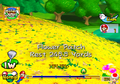 A flower patch from Mario Golf: Toadstool Tour

Beach bunker[edit]

Beach bunkers act similarly to their regular counterparts. However, they do not affect the ball's lie nearly as much, thus making it easier for the player to hit out of.
In Toadstool Tour, beach bunkers appear on Blooper Bay. They can be found in the shapes of food, Bloopers, and many other different objects.
Grass bunker[edit]

Grass bunkers affect the ball's lie the most, making them extremely difficult for the player to hit out of. These appear only on Hole 1 of Bowser Badlands in Toadstool Tour.
Waste area[edit]

Waste areas affect the ball's bounciness with their high friction. Their effect on the ball's lie is minimal, so it is relatively easy for the player to hit out of one. In Balmy Dunes, waste areas appear near quicksand, which acts as the penalty area of the course.
Fringe[edit]
The fringe, known as the green edge prior to Mario Golf: Toadstool Tour, is a narrow strip of grass surrounding the green. The fringe is cut to a length between the fairway and the green itself.
Green[edit]

The green of the hole is where the pin, flag, and hole are located, and as such, it forms the outer target players must aim for. The green is usually surrounded by a fringe. Golfers generally use only putters to strike the ball while on the green. The location of the hole always changes on the green.
Tournament green[edit]

Tournament greens are variations of standard greens that produce less friction on the ball, making it roll farther than when it lands on regular greens. They have appeared in all Mario Golf games since Mario Golf: Toadstool Tour.
Tournament greens are first found in the Star Tournament of that game as an additional challenge, but they can be used in any course once the player beats that course in the Star Tournament. In Mario Golf: World Tour, they appear only in Expert Tournaments, which are regional tournaments played without a flight path, and major world tournaments, namely the Castle Tournament, Star Open, Moon Open, and World Championship.
Hole[edit]

The hole is the name of each playing area within a golf course, and of the small circular pit in the ground that is the ultimate target (the latter sometimes referred to as the cup) of each one. In order to complete a hole, the player must sink the golf ball in the cup, which is located on the green. The pin sticks out of the cup to indicate its exact spot.
In Mario Golf: Toadstool Tour, a cup can sometimes release special particle effects, especially if golfers successfully putt from a certain distance and score under par. In Mario Golf: World Tour, flashes of light come out of the cup if golfers score par or better. When golfers are not yet on the green, the cup glows with a ray of light to signal them of its location.
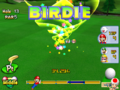 The hole releasing particle effects
_-_MGTT.png)
Out of bounds[edit]

"Out of bounds" (also formatted as Out of Bounds, Out-of-bounds, or Out-of-Bounds), and abbreviated as OB (also formatted as O.B.) or OOB (also formatted as O.O.B.)) refers to an area outside the boundaries of the golf course. If a player hits the ball where it lands outside the boundaries, falls off the edge, or lands in lava, in a Chain Chomp pit, or elsewhere that is not in the main course, the ball is registered as out of bounds. Some sort of signal usually appears when the player hits the ball out of bounds. The penalty for going out of bounds is one stroke, added on to the player's current score for the hole. The player must then hit the ball from the same place that they hit the out-of-bounds shot. In NES Open Tournament Golf and Mario Golf for the Nintendo 64, Toad is the one to alert the player of an out-of-bounds shot, while in Mario Golf: Toadstool Tour, a Koopa Paratroopa is the one to alert the player.
When an out-of-bounds shot happens, the announcer says, "Oh, too bad!" in Mario Golf for the Nintendo 64. In Mario Golf: World Tour, the announcer says either "Out of bounds!" or "Too bad!" instead (and Blue Toad holds up an OB sign). In Mario Golf: Super Rush, the Toad commentary (if enabled) says, "That's OB for <player>!"
Out of course[edit]
In Mario Golf for the Nintendo 64, holes are rendered as isolated "islands" floating in a void, similar to the levels of Super Mario 64. If a player shoots their ball beyond the boundaries not merely of the hole but the entire "island" and into the void, the text message "out of course" is displayed onscreen instead of Toad waving his flag. This is functionally identical to a standard OB. The announcer (as well as the other players, if the game is played in multiplayer mode) calls out "Fore!" half a second after the ball is hit if it is determined that it will go out of the course.[1] (If the ball stops less than half a second after the shot, "Fore!" is not called. Should the ball stop exactly half a second later, the announcer keeps on saying, "Fore!" for two seconds while "Oh, too bad!" is said just once.) This term also appears in NES Open Tournament Golf; should the player hit the ball off the box where the course is located, Toad waves his flag and calls an OB.
Penalty area[edit]
In Mario Golf: Super Rush, all penalty-incurring lies, including water hazards and quicksand, are referred to as penalty areas. This also includes lava and pits, areas considered to be out of bounds in previous games. When the player lands in a penalty area, they are given a one-stroke penalty and must hit the ball at the nearest playable lie.
Pin[edit]

The pin, also known as the flagpole, marks the location of the hole, and the flag is used to make it stand out a little more. Whenever the ball hits the pin, it is called a "Pin Shot," usually making the ball bounce back. Usually, the pin is removed when players make shots on the green so that the ball can enter the hole more easily, though in Mario Golf: Super Rush, the pin remains.
 Mario Golf for the Game Boy Color
 Artwork of a pin from the Mario Golf: Super Rush website


Play panel[edit]

Play panels are exclusive to the Mushroom Course in Mario Golf: Advance Tour. The ball stopping on one causes an event to occur depending on the hole. For example, on the fourth hole, the panel detonates nearby Bob-ombs, and on the thirteenth hole, it causes the Piranha Plants to switch places. As a lie, it is comparable to fairway in how it affects the ball.
Rock[edit]
Rock is terrain that does not have much friction and causes balls to bounce out of it. When a ball lands on it, it hurts the ball's lie, though not as much as grass bunkers or heavy rough.
Rough[edit]

The rough is the area of the courses where the grass is thicker than the fairway. There are five different types of rough seen on the courses; each one has a different effect on the player's landing and shot along with darker coloring as the effects of the rough intensify.
Semi-rough[edit]
Semi-rough is a shallow type of rough that looks very similar to the fairway. Though hardly visible, the semi-rough slightly impairs the player's shot out of the patch, making the ball not go as far or land in another place. It is usually the edge boundary between the fairway and the rough.
Regular rough[edit]
Standard rough is in almost every course. It looks like much thicker blades of grass (when compared to the fairway). Rough is usually located near the fairway or near a bunker. Rough impairs the player's shot out of the patch, making the ball land in a completely different place from where planned.
Heavy rough[edit]
Heavy rough (also known as deep rough) is the deepest and most dangerous type of rough available on a course. It appears as very deep grass and is usually located near the boundaries of the course. Heavy rough severely impairs the player's shot out of the thick patch; it usually takes a high shot to get the ball out, though it lands only a few yards away. When the ball goes into the rough, the announcer says, "Ooh, into the rough!"
Short rough[edit]
Short rough (known as semi-rough prior to Super Rush) is the weakest type of rough available on a course. It appears in every Mario Golf game and is located just before the rough on a course. As its name implies, it affects the ball's lie the least out of all the types of rough.
Heath[edit]

Heath is a type of rough in golf that affects the lie of the ball the most heavily out of all types of rough, including the heavy rough. Players cannot hit the ball very far when in the heath, the power meter charges up more quickly when the player starts a swing, and the sweet spot gets heavily lowered for the harder hitting clubs such as wood, to the point that if the player does not align the bar properly in the perfect spot, they duff the ball. This terrain first appears in Mario Golf for the Game Boy Color and Mario Golf: Advance Tour, appearing on the Coo-Coo Course and the Links Course. In Mario Golf: Toadstool Tour, this hazard is found only in Bowser Badlands, and it appears either in the outside of edges of the course or as small patches interspersed in the fairway. The heath reappears in the Gold Links course of Mario Sports Superstars, replacing some of the heavy rough with the heath.
Gallery[edit]
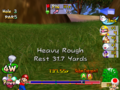 Heavy rough in Mario Golf: Toadstool Tour
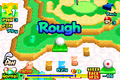 Rough in Mario Golf: Advance Tour
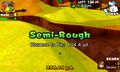 Semi-rough in Mario Golf: World Tour
 Artwork from Mario Golf: World Tour


Teeing area[edit]

The teeing area (formerly tee box) is the starting point in all holes of a golf course. Teeing areas have two tee markers, and the tee, which holds the ball, is placed between them. The number of teeing areas per hole varies with each game in the Mario Golf series. In the Nintendo 64 game and its Game Boy Color counterpart, each hole has one tee box. In Mario Golf: Toadstool Tour and Mario Golf: Advance Tour, back tee boxes are added, and they are farther from the green than front tee boxes. In these games, back tee boxes are used in Star Tournaments, which are harder than their regular versions where front tee boxes are used. In Mario Golf: World Tour, there are three tee boxes per hole (except in Sky Island, whose holes have one tee box each) and the third is called a tournament tee box, which is even farther from the green than the back tee box. The front tee boxes are used in stroke plays in the Castle Club, Mario Open tournaments, most regional tournaments, and Star Coin challenges. The back tee boxes are used in course championships, regular regional tournaments, expert tournaments, world tournaments, and the harder Moon Coin challenges. The tournament tee boxes are used in costume challenges, major tournaments, and the World Tour Final. Shots made from the teeing area are referred to as tee shots, and in World Tour, insets appear on the screen, showing the characters doing gestures indicating whether the tee shots are good or bad. Mario Golf: Super Rush adds a fourth tee, the rookie tee. This teeing area is the closest to the course, being even closer than the standard tees.
Tree hazard[edit]
A tree hazard serves a purpose; this event occurs only when the player's golf ball gets stuck in a tree and will not come down or when it lands too close to a tree trunk. The penalty for aiming at a tree is the same as a regular out-of-bounds shot. However, if a ball goes into a tree, the player has to hit the ball from wherever they aimed it.
Water hazard[edit]
- Main article: Water

A water hazard is a body of water on the course. The penalty for hitting into a water hazard is the same as a regular out-of-bounds shot. However, if a ball goes into the water, the player must hit the ball a yard or two from the edge of the nearest land area from where the ball entered the water; this is called a drop.
In Mario Golf for the Nintendo 64 and Mario Golf: World Tour, the announcer says, "Oh, too bad!"[2] In Mario Golf: Super Rush, the Toad commentary (if enabled) says, "<Player's> ball went into the penalty area." In Super Rush, during a match of Speed Golf, it is also possible for the player to go into the water, in which case the Toad commentary (if enabled) says, "<Player> fell into the penalty area!" The player also flashes as if they were shrunken by an obstacle and lost their power. Some characters can cross water by using their Special Dashes.
Wood[edit]

When the ball lands on wooden surfaces in Mario Golf: Toadstool Tour and Mario Golf: Super Rush, it is said to land on wood. Like with rock, pipe, or brick, the ball frequently bounces off it. Like those three terrains, it also hurts the ball's lie. In Super Rush, it is extremely rare to land on wood bridges without handles, as it would simply head into the water.
Unplayable[edit]

- “A ball that cannot be played because of the terrain. There's a one-stroke penalty to drop the ball.”
- —Golf Glossary, Mario Golf: World Tour and Mario Golf: Advance Tour
"Unplayable" refers to an area within the boundaries of a hole comprised of terrain that the ball may not be played from. Similar to out of bounds and water hazards, it attracts a one-stroke penalty.
Unplayable areas are not in specific areas of a golf course. For example, if the ball is in front of a tree and cannot go straight to move on the course, it is not a formally unplayable area, even if a player faces difficulty in playing it. Rock and flower patches do not count as unplayable areas. Wood can be considered "unplayable," such as the cabin on Hole 10 of Forest Course[3] or the bridge on Hole 4 of Bowser's Castle.[4]
Scores[edit]
This section needs Mario Golf improvement. Specifically:
- Info on how all scores are scored on each par hole
Albatross[edit]
- This section is about the golfing term. For the birds that are named albatrosses in Game & Watch Gallery 3, see Seagull. For the enemy that first debuted in Yume Kojo: Doki Doki Panic, and later in Super Mario Bros. 2, see Albatoss.

An albatross (also called a double eagle) is a score of three under par for a given hole. Albatrosses are extremely difficult to perform, and they usually require a character that can shoot the ball a great distance to perform them (such as Petey Piranha, King Bob-omb, Donkey Kong, Bowser, or Metal Mario). Albatrosses are usually done by means of chip-ins, though on some par 5 holes, depending on wind conditions, it is possible to land on the green from the tee box and then sink the albatross putt to get an albatross without a chip-in. It's only possible to get albatrosses on holes that are par 5 or more, as landing an albatross on a par 4 would result in a Hole-in-One instead.
In the Club Slots mode in Mario Golf: Toadstool Tour, an albatross gives the player five points. When played by Point Play rules in Mario Golf: World Tour, albatrosses are worth eight points, which are worth the same as a hole-in-one.
In Mario Golf for the Nintendo 64, if a player gets on the green in one stroke on a par 5 hole, they receive the Albatross Putt message in rainbow colors when they start their putt, while they are rainbow-colored on the scorecard. They are given a golden color on the Mario Golf: Toadstool Tour scorecard and a half-yellow and half-gold color in Mario Golf: Super Rush.
In Mario Golf: Toadstool Tour and Mario Golf: Advance Tour, the color of Albatross Best Badges is red.
Gallery[edit]
- Albatross end-of-hole animations
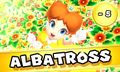 Daisy in Mario Golf: World Tour
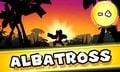 Donkey Kong in Mario Golf: World Tour
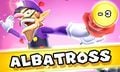 Waluigi in Mario Golf: World Tour
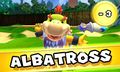 Bowser Jr. in Mario Golf: World Tour
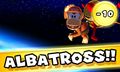 Diddy Kong in Mario Golf: World Tour
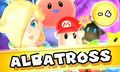 Rosalina in Mario Golf: World Tour


Birdie[edit]
- This section is about the golfing term. For the character, see Birdo.

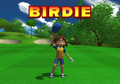
A birdie is a score equal to one below par. Birdies can be achieved on all holes, and any character can achieve them. In Mario Golf: Toadstool Tour and Mario Golf: Advance Tour, Birdie Best Badges are blue, whereas in Mario Golf: World Tour, they are silver. In all games, every time characters get a birdie on a hole that they have not gotten a birdie result in during a tournament, they get one Birdie Badge. Earning enough badges can unlock content, depending on the game that is being played.
On the scorecard, birdies are colored orange in the Nintendo 64 version of Mario Golf, while they are half-white, half-red in Mario Golf: Toadstool Tour and orange in Mario Golf: Super Rush.
In other game modes[edit]
- Birdie is the lowest score that earns the player a Birdie Badge in tournament mode.
- When playing Club Slots in Mario Golf: Toadstool Tour or by Point Play rules in Mario Golf: World Tour, a birdie gives the player three points.
- The Birdie Challenge mode in Mario Golf: Toadstool Tour requires the player to get a birdie in each hole; otherwise, they fail the challenge.
Gallery[edit]
- Mario Golf (Nintendo 64)


- Mario Golf (Game Boy Color)

- Mario Golf: Toadstool Tour
 Neil
Neil


- Mario Golf: Advance Tour


- Mario Golf: World Tour